Where the protocol is silent, the plan holds an open decision. A first plan may have twenty. The decision interview takes them one at a time.
The interview#
Run Sapling: Work Through the Open Decisions. For each decision you see:
- the question in one line;
- the sentence of the protocol that bears on it;
- What good SAPs do, from the knowledge base, when an item bears on it, with its guideline source;
- options, one of them suggested, each with a line on when it fits;
- a free-text field for your own answer.
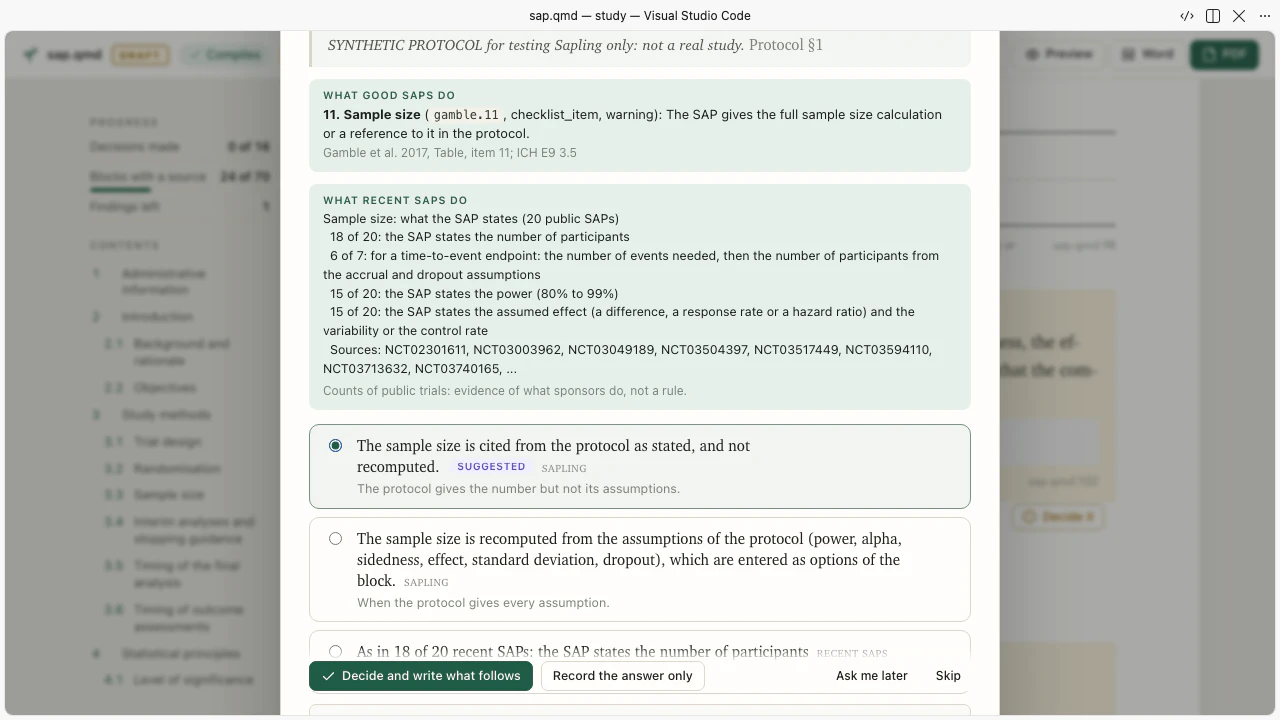
Decide and write what follows records your answer with your name and today's date. Where Sapling has a generator for the option (for example the multiplicity procedure, an estimand's intercurrent event, a missing-data block, a sensitivity analysis), the blocks that follow are written in the same step as a proposal compiled in its place. Record the answer only keeps the decision without writing blocks. Ask me later and Skip are there too.
Proposals#
A proposal is one change of the plan: a block inserted, replaced or deleted. It carries a short title, a reason, the protocol sentences it cites, and the result of compiling the plan with the change. A proposal that does not compile cannot be accepted.
In the page, a new block has a green edge. A change shows as the block now beside the block proposed, with the changed words marked. A deletion is struck through. Then you choose:
- Accept applies it as one edit; one undo takes it back.
- Decline asks for an optional reason, kept for later.
- Improve... lets you tell Sapling what to change in this proposal ("use Hochberg, not Holm").
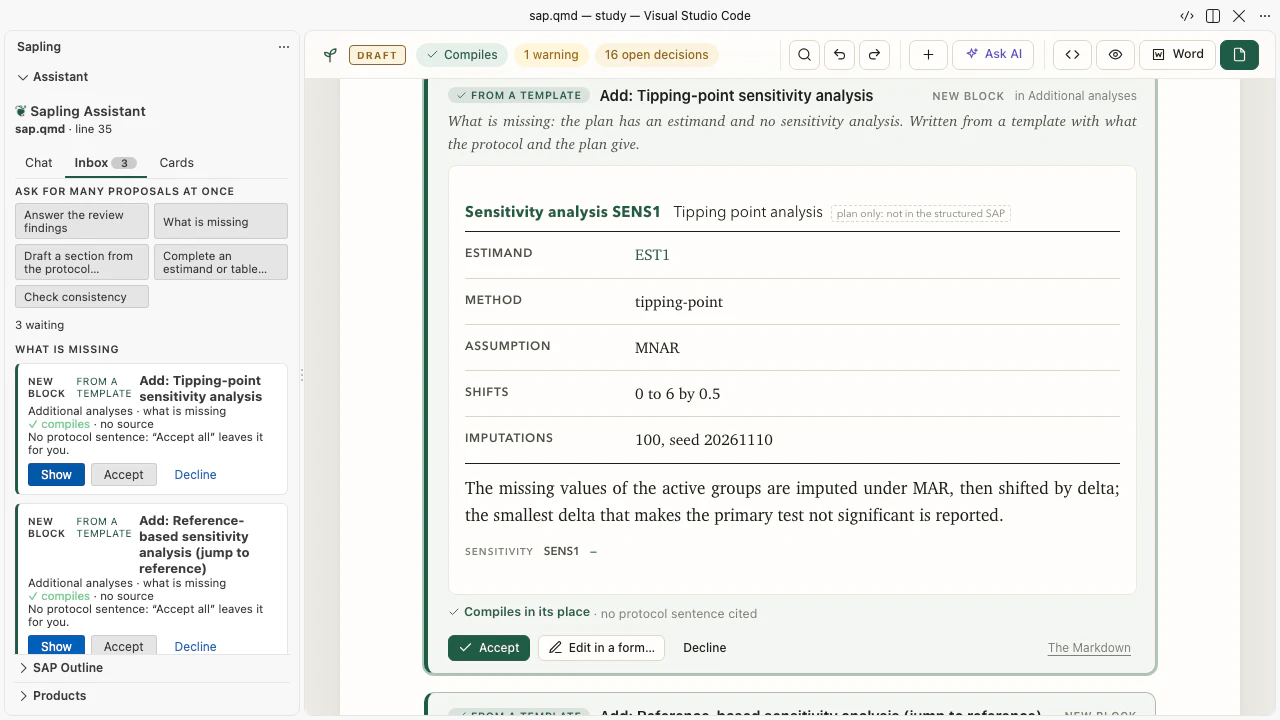
The assistant panel has an Inbox of proposals, a Chat, and Cards. Each proposal says where it comes from: from the rules, from a template, or an AI proposal. A task such as Answer the review findings or What is missing makes many proposals at once; Accept all that compile and cite the protocol lists what it will apply and asks once.
House rules#
Plain sentences in .sapling/rules.md of the study ("Continuous efficacy endpoints: MMRM with unstructured covariance, Kenward-Roger") are read first when options and proposals are made. A shared file for a company standard is the setting sapling.ai.rules. The protocol wins: when a rule and the protocol disagree, Sapling says so and offers a decision.
More about how this works: the assistant reference.